

My little cousin came home last week and pulled out this tablet thing from his school bag.
I asked him what it was for and he said, "we use it in science class now."
I just sat there for a second. Because when I was his age, we were still copying diagrams from a textbook by hand.
That moment stuck with me. And I ended up going down a full rabbit hole on gadgets education and how much things have actually changed in the last few years.
So let me share what I found because some of this genuinely surprised me.
Why Schools Are Suddenly Full of Gadgets
Okay so here is the thing I did not fully understand before I started researching this.
Schools did not just randomly start handing out devices. There was a slow shift happening over years and then the pandemic basically slammed the accelerator on everything.
When schools went remote, teachers and students had no choice but to figure out how to learn through screens.
And what happened after that is interesting. A lot of teachers realized that some of the digital tools they were forced to use were actually really good.
So when classrooms came back, the gadgets came with them.
I think that is where the whole conversation around gadgets education really started picking up speed. It stopped being a "future thing" and became a right now thing.
What I Actually Found When I Dug Into This
I went in expecting to find a mixed bag of opinions. Some people saying it is great, some people saying kids should just read books.
But the stuff I kept coming across pointed in one direction pretty clearly.
When gadgets are used with actual purpose and structure, kids learn faster.
Not because screens are magic. But because when I am interacting with something, dragging it, building it, seeing it move, my brain holds onto it differently than when I am just reading text on a page.
That is just how memory works. Active learning beats passive learning almost every time.
And gadgets, when used right, are one of the best tools we have ever had for making learning active.
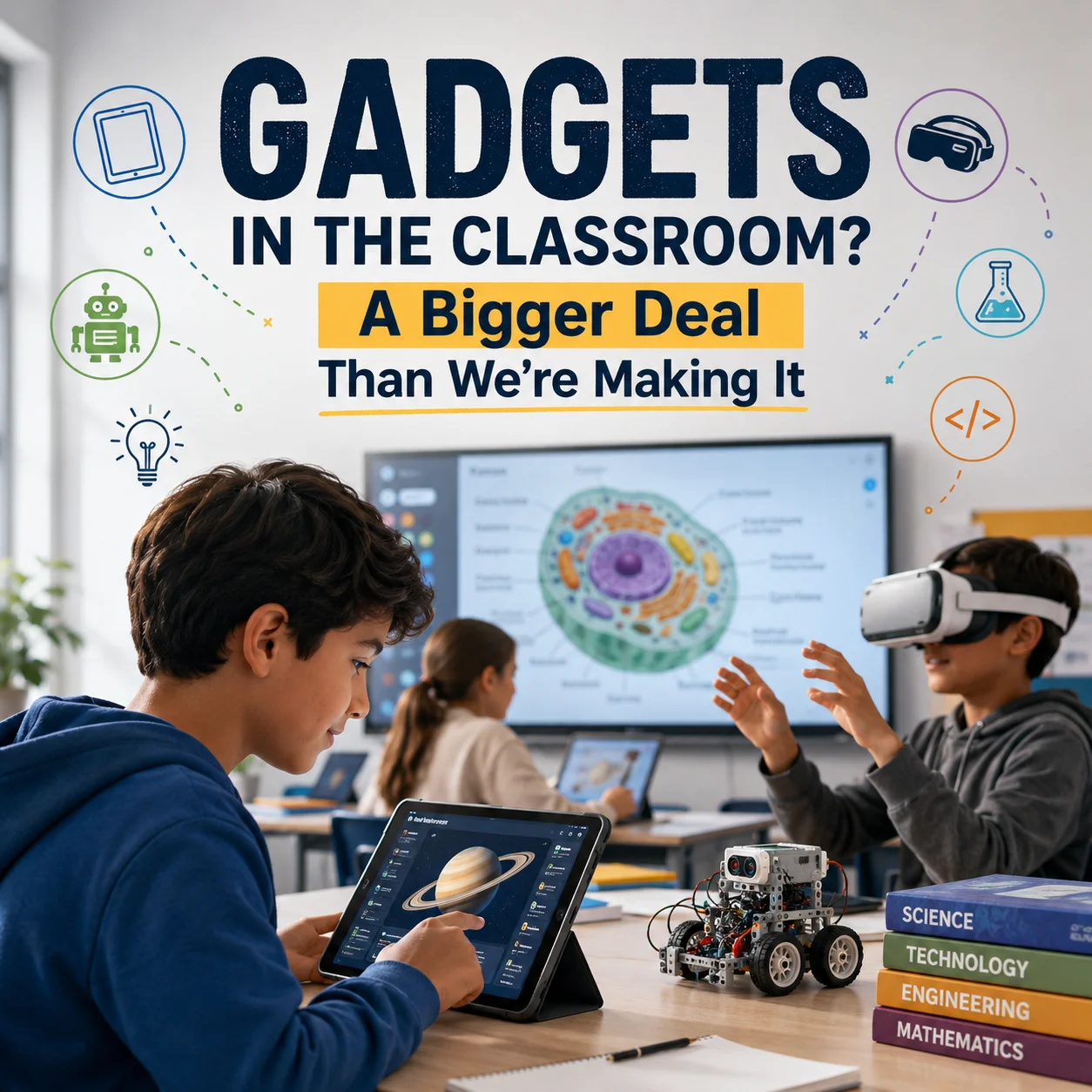 The Stuff Being Used in Classrooms Right Now
This is the part that actually got me excited when I was researching. Because the range of what counts as gadgets education today is way broader than I expected.
Tablets
These are everywhere now. Teachers use them for quizzes, group reading, drawing, coding games, everything.
We have basically replaced printed worksheets with interactive screens and for the most part it seems to be working.
Smartboards
Remember those old whiteboards with the squeaky markers? Gone in a lot of places.
Smartboards let teachers pull up videos mid-lesson, drag things around, zoom into diagrams, and actually get students to come up and interact with the content.
It makes the front of the room something students actually look at instead of zone out from.
VR Headsets
Okay this one I was not expecting to find in actual schools right now but it is happening.
Some students are taking virtual field trips through VR. We are talking walking through ancient Rome, exploring the ocean floor, standing inside a human heart.
That kind of experience is something no textbook page can touch.
Coding Kits and Robotics
These are becoming a big thing especially in middle school programs.
Kids build small robots and write basic code to control them. It teaches logic, problem solving, and patience all at once.
And they actually enjoy it because it feels more like building something than studying something.
Science Simulation Tools
Instead of waiting once a week for lab time, students can run experiments on screen whenever they need to.
Chemistry simulations, physics models, biology diagrams they can pull apart layer by layer.
This is where gadgets education does something really unique. It makes things visible that would otherwise just be words on a page.
The Skill Nobody Is Talking About
Here is the part I did not expect to write about but I think it matters the most.
When we talk about gadgets in schools we always focus on the subject being taught. Science, math, history.
But the bigger thing being built is digital literacy.
And that is genuinely one of the most important skills a person can have right now.
Every job, every industry, every side hustle you can think of involves navigating technology in some way.
Kids who grow up comfortable with devices, who know how to research things properly, filter information, troubleshoot, adapt to new tools, those kids have a real advantage.
I did not have that kind of structured exposure when I was young and I spent a lot of time catching up on my own later.
The gadgets education happening in classrooms right now is giving kids a head start that I think a lot of adults are underestimating.
But Let Me Be Real About the Problems Too
I am not going to sit here and just hype everything up. There are actual issues with this and they deserve to be talked about.
Screen time is a real concern.
When a kid is on a screen for six hours straight at school and then comes home and does the same, that adds up fast.
Eyes, posture, sleep quality, attention span. All of it gets affected. Schools need actual limits and parents need to pay attention too.
Not every school can afford this.
This is the one that actually bothers me the most.
The benefits of gadgets education are real but they are not equally available. A lot of schools, especially in smaller cities and rural areas, just do not have the budget for tablets and smartboards and VR kits.
And that gap between students who have access and students who do not is not small. It is growing.
We can get excited about the technology all we want but the access problem is something we really need to talk about more.
Distraction is not imaginary.
Give a 13 year old a tablet in class and tell me they are definitely going to stay on the lesson the whole time.
I was 13 once. I know exactly what would have happened.
Good programs build in monitoring tools and clear rules and teacher oversight. But it takes real effort to make that work consistently.
Some basic skills are getting weaker.
This one is more of a gut feeling from what I read but it kept coming up.
Mental math, handwriting, reading long texts without looking for shortcuts. Some of these are quietly declining in kids who have always had a device available.
Gadgets education should add to the fundamentals, not quietly replace them.
What This Looks Like in the Next Few Years
Okay this is the part I genuinely find exciting to think about.
We are not even close to where this is going.
AI is already being built into some learning platforms. And the direction it is heading is personalized education, where a tool actually adjusts to how your specific kid learns in real time.
Not the same lesson for every student. A different path for every brain.
That is not a dream anymore. Early versions of it are already being tested.
Augmented reality is also coming into this space fast. Instead of needing a full VR headset, AR overlays information on the real world through a regular tablet camera.
Point your tablet at a diagram and it comes to life. Point it at a plant and it labels every part live on screen.
That kind of gadgets education experience changes what a classroom can even be.
We are also going to see more global collaboration tools. Students in different countries working on the same project together through shared digital spaces.
The classroom walls are basically becoming optional.
What Parents Can Actually Do With This Information
If your kid's school is already doing this stuff, here is my honest take.
Do not fight the gadgets. Work with them.
Ask your kid what they learned on their device today. Show actual interest. That one habit makes a bigger difference than you think.
Set clear boundaries between school device time and free time. Those two things should not blur together at home.
And if you want to support gadgets education outside of school, there are tools made specifically for home learning that are actually pretty affordable.
Coding toys, interactive science kits, learning apps that are genuinely good. You do not have to spend a lot to make an impact.
FAQs
Are gadgets actually helping kids learn better?
When used with structure and purpose, yes. Interactive learning helps kids retain information faster than passive reading alone.
What age should kids start using gadgets for education?
Most programs start around five or six with simple tools and build from there as kids get older.
Is gadgets education just for tech subjects?
Not at all. We are seeing devices used in history, languages, arts, and even physical education now.
Do gadgets replace teachers?
No. The gadget is the tool. The teacher is still the one making sense of it all and guiding the learning.
What if my kid's school cannot afford this technology?
It is a real problem. Some communities have programs and nonprofit initiatives that provide devices to underfunded schools. Worth looking into locally.
Does screen time at school count against daily limits?
Most child health guidelines say yes. Total screen time across all settings adds up so it is worth tracking.
Can kids learn coding through gadgets education at home?
Yes and there are some really good beginner kits and apps designed exactly for that. You do not need to be a tech person to get started with your kid.
Look, I started this whole thing because my cousin pulled a tablet out of his school bag and I was curious.
I did not expect to find myself genuinely invested in the topic by the end of it.
But here is what I keep coming back to. The way we learned was not the only way. And for a lot of subjects, it was not even the best way.
The kids going through school right now have access to tools that can make learning click in ways a textbook just cannot.
And yeah there are problems we need to fix. Access, screen time, distraction. All real.
But the direction this is heading is good. And I think we should be paying more attention to it than we are.
My cousin is going to understand things at 12 that took me until 20 to figure out.
And honestly that is kind of amazing.