

Quick AnswerSkechers shoes are primarily manufactured in China and Vietnam through independent contractor factories, with additional production taking place in Indonesia and Cambodia. Skechers is an American brand headquartered in Manhattan Beach, California, but none of its shoes are made in the USA. Founded in 1992 by Robert Greenberg, Skechers is now the third-largest footwear brand in the world by sales. The company maintains strict quality control across all manufacturing locations even though it does not own the factories directly.
Where Are Skechers Shoes Manufactured?
Skechers operates a global manufacturing network that spans several Asian countries. This setup allows the company to manage production costs, keep its supply chain flexible, and meet the massive worldwide demand for its comfortable footwear.
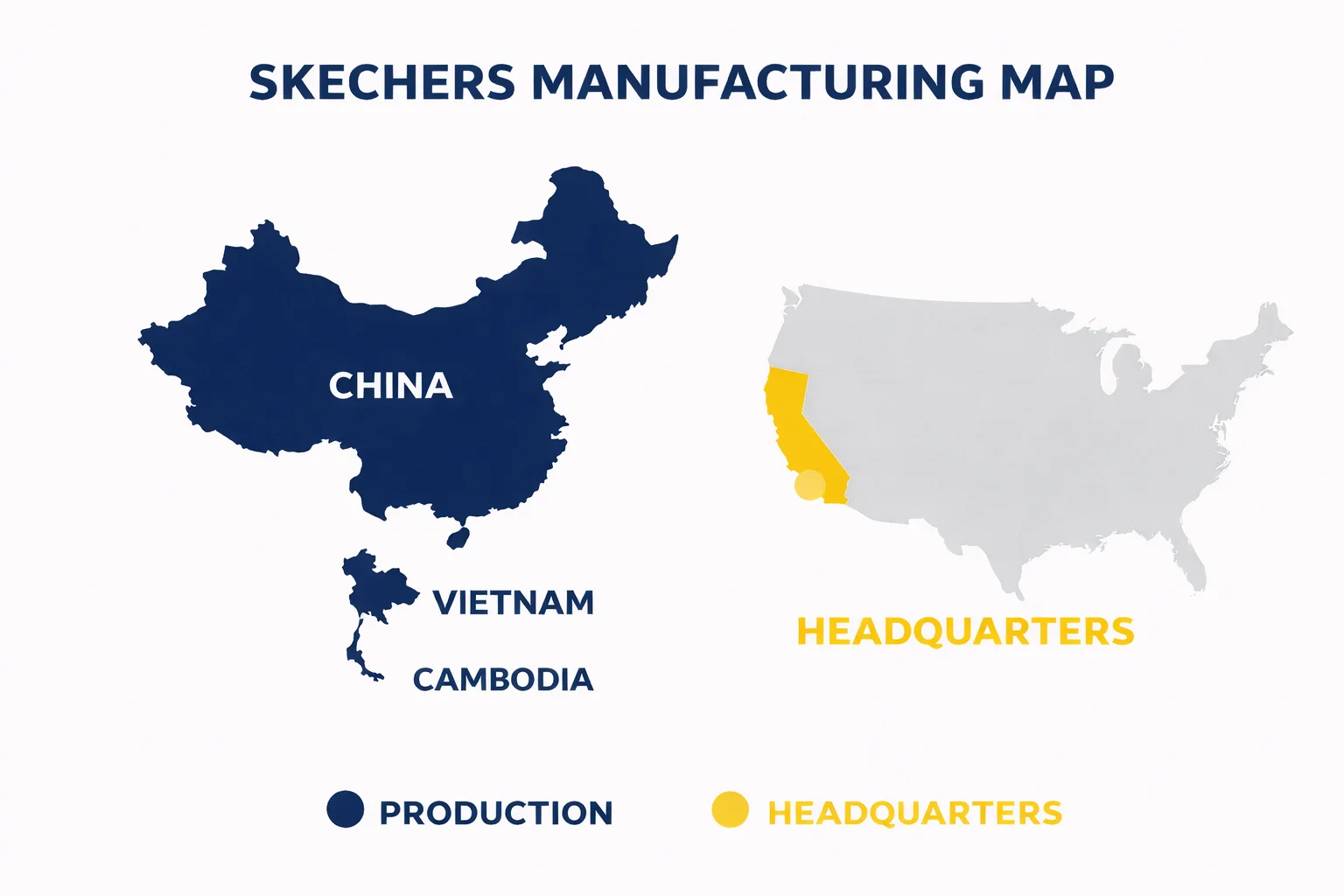 Primary Manufacturing Countries
Country | Production Focus | Key Facilities | Market Share |
|---|---|---|---|
China | All shoe categories, socks | Dongguan, Putian City, various provinces | Largest share (~60–70%) |
Vietnam | Athletic shoes, performance footwear | VSIP Binh Duong, multiple facilities | Second largest (~25–30%) |
Indonesia | Casual and lifestyle shoes | Various partner factories | Small percentage |
Cambodia | Assembly and finishing | Growing manufacturing hub | Emerging role |
Dongguan, Guangdong is one notable location where Skechers works with Dongguan Luzhou Shoes Co., Ltd., which plays a big role in the brand's footwear output. China's Putian City is another important manufacturing hub where Skechers produces shoes alongside other well-known athletic brands like Nike, Adidas, and Puma.
Why Skechers Manufactures in Asia
Skechers manufactures in Asian countries because of lower production costs, a skilled workforce, strong supply chain networks, and large-scale factory operations. These countries have built up their footwear industries over decades, which makes them ideal for producing shoes at a competitive price while still meeting quality standards.
Key Advantages of Asian Manufacturing
Cost efficiency: Labor costs and raw materials are much more affordable in Asia than in the United States or Western Europe. This allows Skechers to produce shoes at prices that everyday consumers can actually afford.
Skilled workforce: Workers in China and Vietnam have specialized knowledge in footwear assembly, including cutting, stitching, and molding techniques built up over years of experience.
Supply chain infrastructure: Easy access to rubber, synthetic fabrics, and other raw materials at competitive prices reduces production time and cost significantly.
Production scale: Asian factories can produce thousands of pairs daily while maintaining consistent quality across large orders.
Manufacturing flexibility: Working with independent contractors lets Skechers scale production up or down based on seasonal demand without large capital investments.
Manufacturing Strategy
Skechers does not own these factories. Instead, it works with outside suppliers — an asset-light approach that gives the company significant flexibility. This model allows Skechers to increase production quickly without spending capital on new facilities, manage costs by negotiating with multiple suppliers, spread risk across different countries and factories, and maintain quality through on-site inspection teams placed directly at manufacturing locations.
The company keeps quality control staff at these factories to oversee how shoes are made even without owning the buildings themselves. This means each pair should meet the same standards whether it came out of a factory in China, Vietnam, or anywhere else in the network.
Are Skechers Made in America?
No, Skechers shoes are not made in the USA. Even though Skechers is an American company with its headquarters in California, it does not use any American factories for shoe production. All manufacturing happens overseas, mainly in Vietnam and China.
According to industry data, approximately 98 to 99 percent of shoes sold in the United States come from foreign countries. Higher labor costs have made domestic footwear manufacturing too expensive for mass-market brands. Major brands including Nike, Adidas, and Skechers have all moved production overseas for this reason.
Design and Development — Still 100% American
While manufacturing happens far from home, Skechers keeps its American identity very much alive through its California-based operations. The company's headquarters in Manhattan Beach handles all product design and development, including comfort technologies like memory foam and Arch Fit systems. Corporate operations such as marketing, sales, and distribution are all managed from California as well. In 2019, Skechers expanded its California headquarters, doubling the office, design, and showroom space in the South Bay area.
Who Owns Skechers?
Skechers is a public company, but it is still run by the family that founded it. Robert Greenberg started Skechers in 1992 and continues to serve as chairman. His son, Michael Greenberg, is president and helps guide the company's day-to-day operations.

Stakeholder | Ownership Type | Details |
|---|---|---|
Robert Greenberg | Founder & Chairman | Founded the company in 1992 after stepping down from LA Gear |
Michael Greenberg | President & Co-Founder | Son of Robert; leads day-to-day operations |
Public Investors | ~80% of shares | Major institutional investors include BlackRock and Vanguard |
Skechers went public in 1999, which allowed the company to raise capital for expansion while the Greenberg family maintained significant influence over its overall direction.
Company History
Robert Greenberg had previously founded LA Gear in 1983, stepping down as CEO the same year he started Skechers. He originally wanted to focus on men's street shoes, and Skechers' earliest products were utility-style boots that became popular in the grunge fashion scene of the early 1990s.
The company expanded quickly after that. In the mid-1990s it added women's and children's shoes to its catalog. It went public in 1999. In 2011 it launched a performance sportswear line for athletes and signed distance runner Meb Keflezighi as a brand ambassador. In 2023, Skechers made its debut on the Fortune 500 list. Today, the brand sells footwear, apparel, and accessories in more than 180 countries through retail stores, e-commerce platforms, and wholesale partnerships.
Where Is Skechers Headquarters?
Skechers U.S.A., Inc. is headquartered in Manhattan Beach, California, a beach city in the South Bay region of Los Angeles County. The company significantly expanded this headquarters in 2019 to double its office, design, and showroom space.
The Manhattan Beach location serves as the central hub for product design and development, marketing and brand management, corporate leadership and strategic planning, North American distribution coordination, and customer service and support.
Manufacturing by Country
China Manufacturing
A large portion of Skechers shoes comes from China, making it the brand's primary manufacturing base. Chinese factories handle the full process — from cutting and stitching the uppers all the way to final assembly and packaging.
Some notable Chinese facilities include Putian City in Fujian Province, which became a major shoe manufacturing hub back in the 1980s, and Dongguan in Guangdong Province, where Skechers partners with Dongguan Luzhou Shoes Co., Ltd. The brand also works with multiple contractor facilities scattered across China's industrial regions.
It is also worth noting that all Skechers socks are made in China. The brand relies entirely on Chinese factories for its athletic and casual sock lines.
Important context: There have been reports about Uyghur workers being relocated to factories across China. Skechers responded by conducting audits at its partner facilities and stated firmly that no evidence of forced labor was found. The company opened a store in Ürümqi, Xinjiang in September 2024 while this scrutiny was ongoing.
Vietnam Manufacturing
Vietnam offers more affordable labor and materials, making it an attractive production base for Skechers. The country has become increasingly important in the company's supply chain over the last several years.
Many of Skechers' athletic shoes, including popular running and walking styles, are made in Vietnam. One known production location is VSIP Binh Duong, Vietnam, where shoes are produced through Kingmaker Vietnam Footwear Co. This same manufacturer also makes shoes for Timberland, Clarks, Wolverine, and Stride Rite — a strong indicator of the quality standards that Vietnamese footwear factories can deliver.
Strategic reasons for Skechers expanding into Vietnam include diversifying away from a single-country dependence, responding to rising labor costs in China, reducing exposure to certain import tariffs, and gaining access to a workforce that specializes in athletic footwear. The expansion into Vietnam also proved valuable during the COVID-19 pandemic, when supply chain disruptions in other regions made it critical to have production spread across multiple countries.
Indonesia and Cambodia
Cambodia is another country where Skechers produces footwear. While smaller compared to China and Vietnam, its role is growing. Cambodian factories typically focus on assembling shoes and finishing final details rather than full production runs.
What makes Cambodia appealing to manufacturers is its affordable labor costs, government encouragement of foreign manufacturing investment, and the additional flexibility it brings to Skechers' overall supply chain.
Indonesia also contributes to Skechers production, though at a smaller scale than China or Vietnam. Indonesian factories primarily handle casual lifestyle shoe categories.
Other Potential Manufacturing Locations
While Skechers' primary production is concentrated in China, Vietnam, Indonesia, and Cambodia, the brand has connections to other markets as well. Skechers signed an exclusive deal with Grupo Charly in Mexico in 2010, though this partnership was focused primarily on distribution to Mexican markets rather than manufacturing for global export. The brand sells in over 180 countries, so its logistics and supply chain reach is genuinely worldwide.
Are Skechers Good Shoes?
The answer really depends on what you plan to use them for. Skechers are genuinely good shoes for everyday comfort, casual wear, and light activity. Some styles perform extremely well, while others may fall short if you need serious foot support or expect them to last through intense daily exercise over several years.
Strengths of Skechers Shoes
Comfort is where Skechers consistently earns the most praise. The cushioned midsoles and memory foam insoles really do make a difference, especially for people who spend long hours on their feet. Nurses, retail workers, and teachers regularly name Skechers as some of the most comfortable work shoes they have tried.
Air-Cooled Memory Foam insoles: Personalized cushioning that adapts to the shape of your foot over time
Arch Fit technology: Podiatrist-certified arch support systems designed for all-day wear
Generous cushioning: Thick midsoles that absorb shock and reduce foot fatigue throughout the day
Breathable materials: Mesh uppers that keep feet cooler than many synthetic alternatives
Value for money is another major selling point. Most Skechers sit in the $50 to $80 range, which is very reasonable compared to the $150-plus price tags you see from bigger athletic names. The brand also runs frequent sales and has outlet locations, so finding a decent deal is rarely difficult.
Versatility is worth mentioning too. Skechers covers a wide range of needs including walking shoes through the Go Walk series, running shoes through their Performance line, slip-resistant work shoes, casual everyday sneakers, and hands-free Slip-ins for easy on-and-off wear.
Weaknesses and Limitations
Durability concerns are the most commonly reported issue. Many buyers notice that the soles start to flatten, the fabric loosens, and the overall structure softens after around six to eight months of regular use. Memory foam insoles, while incredibly comfortable at first, tend to compress and lose their responsiveness over time.
Not ideal for intense activity is another honest limitation. Skechers memory foam shoes are built around comfort rather than stability and control. They feel great walking around, but during running or high-impact workouts, the softness that makes them comfortable can actually work against you. Ankles may feel less stable, and the flat soles do not always provide enough correction for conditions like plantar fasciitis.
Inconsistent fit is a minor but real issue. Different Skechers styles can fit quite differently even within the same size, which makes online buying a bit of a gamble. Trying them on before purchasing is always the better approach when possible.
Best Skechers Models
Best for Walking: Skechers Max Cushioning Arch Fit — excellent all-around performance with strong comfort and quality construction
Best for Comfort: Skechers Summits — cloud-like softness with a non-restrictive toe box that many users love
Best Lightweight: Skechers GoWalk Joy — notably lighter than average while still delivering solid cushioning
Best Slip-On: Skechers Slip-in Max Cushioning Smooth — effortless to put on and take off with a plush feel underfoot
How to Wash Skechers Shoes
Taking proper care of your Skechers extends their life and keeps them looking good. The right washing method depends on the specific material your shoes are made from and whether they are rated as machine washable.
Are Skechers Washable?
Yes — many Skechers models are designed to be machine washed safely. However, you should always check the product page for a "Machine Washable" icon before putting any pair in the wash. Some materials and styles, particularly leather, suede, and light-up shoes, should never go in a machine.
Important warnings: Never put Skechers in a machine dryer. Do not use bleach or hot water. Do not submerge light-up shoes in water, as the electronic components cannot survive it.
Machine Washing Instructions
Step 1 — Preparation: Remove the laces and insoles and wash them separately. Brush off any loose dirt or debris from the surface of the shoe. Check for stains and pre-treat them before placing in the machine.
Step 2 — Washing: Place machine-washable Skechers inside a laundry bag or pillowcase for protection. Use cold water and a gentle cycle with a mild laundry detergent. Avoid bleach or harsh chemicals. Wash only one pair at a time if possible to prevent discoloration. Adding a few towels to the load helps with cushioning and keeps the machine balanced.
Step 3 — Drying: Always air dry completely before wearing or storing your shoes. For models with Skechers Memory Foam insoles, allow at least 10 to 12 hours of air drying to make sure the insole is fully dry inside. Keep them away from direct sunlight or heat. Stuffing the shoes with newspaper while drying helps them keep their shape.
Hand Washing Instructions
For shoes that are not machine washable, mix a few drops of mild laundry detergent with warm water. Dip a soft cloth or clean brush into the solution and gently scrub the shoe's surface. Use a separate clean, damp cloth to wipe away any soap residue afterward. Let the shoes air dry completely, away from any direct heat or sunlight.
Special Material Care
Leather Skechers: Apply a leather cleaner using a soft cloth. Condition the leather occasionally with a leather lotion or oil to keep it from drying out and cracking. Before wearing them in wet weather, treat them with a waterproofing spray.
Suede or Nubuck Skechers: Start by using a suede brush to remove loose dirt before introducing any liquid. Use a specialized cleaner made specifically for suede and nubuck. Never machine wash or fully submerge these materials in water.
Light-Up Shoes: Clean these with a mild soap and warm water mixture using a soft cloth, baby wipes, or a damp sponge. Never submerge them in water under any circumstances.
General Maintenance Tips
Apply a Skechers water proofer spray before wearing shoes in wet conditions
Use a shoe deodorizer spray to keep the inside fresh between wears
Rotate between multiple pairs of shoes to give each pair time to recover and extend overall lifespan
Store shoes in a cool, dry place away from direct sunlight
Address stains as soon as they happen — letting them sit makes them much harder to remove
Do Skechers Run Big or Small?
Skechers generally fit true to size, but individual styles can feel tighter or roomier than expected. Slip-on and memory foam models may feel snug at first and then loosen as the material conforms to your foot over the first few wears.
General Sizing Guidelines
Style Category | Sizing Advice | Notes |
|---|---|---|
Most Skechers | True to size | Order your normal size in most standard styles |
Go Walk Series | May run large | Many customers size down half a size, especially without socks |
Slip-Ons | May feel snug initially | Memory foam adjusts and loosens after a few wears |
Arch Fit | Generous fit | Extra room for comfort — consider going half a size down |
Sandals | Run large | Buy one full size smaller; Skechers sandals do not come in half sizes |
Running Shoes | Sometimes size up | Some buyers go up half a size for athletic performance styles |
Width Options
Classic Fit: Medium width — Women's B, Men's D — standard for average feet
Relaxed Fit: Wider toe box with extra wiggle room — Women's B/C, Men's D/E
Wide Fit: Wider around the entire foot — Women's D, Men's 2E/3E
Extra Wide: Maximum space — Men's 4E/5E
Sizing Compared to Other Brands
Skechers sizing is generally consistent with brands like New Balance, Saucony, ASICS, and Brooks. However, there can be a 0.5 to 1 US size difference compared to Nike and Adidas, since those brands follow slightly different sizing standards. If you are switching from Nike or Adidas, you may not need to size up when buying Skechers.
Practical Sizing Tips
Measure your feet at the end of the day when they are at their largest due to natural swelling
Read customer reviews for the specific model you are buying, as sizing can vary between styles
Try shoes in-store whenever possible since the fit difference between styles can be noticeable
For running shoes, going a half size up is common practice to accommodate foot swelling during exercise
Memory foam insoles compress over time, so a slightly snug fit initially often becomes more comfortable with wear
Skechers Manufacturing in India
India deserves a special mention in the Skechers manufacturing story because it represents a slightly different approach from the company's other locations. Skechers has invested in production facilities in India to serve the country's rapidly growing middle class and expanding demand for branded footwear.
By manufacturing locally in India, Skechers avoids heavy import duties, shortens the supply chain for Indian consumers, and signals a genuine commitment to the Indian market. This matters to local consumers and to government stakeholders who favor foreign companies that invest in domestic manufacturing rather than purely importing finished goods.
India also gives Skechers another layer of supply chain diversification, which is increasingly valuable in a world where trade policies and shipping disruptions can change quickly.
Also Read: Can You Connect AirPods to Switch
Does the Country of Manufacture Affect Skechers Quality?
This is a fair question. Skechers applies the same design specifications and material standards across all of its manufacturing partners regardless of where they are based. In theory, a pair made in Vietnam should meet the exact same quality benchmarks as a pair made in China or Indonesia.
In practice, small variations can exist between factories. A factory that has been producing a specific Skechers model for several years will naturally have more refined processes than one that recently started on that model. But these differences are typically minor and would not be noticeable in everyday use.
The country of origin alone is not a reliable measure of quality in modern footwear. What matters far more is the specific factory, the machinery being used, and the quality control systems that are in place. Skechers maintains oversight at all its partner facilities to keep standards consistent across borders.
Skechers vs. Other Brands
It helps to put Skechers in context with the rest of the footwear industry when looking at manufacturing locations. Nike makes most of its shoes in Vietnam, Indonesia, and China. Adidas also manufactures primarily in China, Vietnam, and Indonesia. New Balance is one of the few major brands that still makes a portion of its shoes in the United States, though most of its output is overseas. Clarks sources mainly from Vietnam and India.
When viewed alongside its competitors, Skechers' manufacturing approach is entirely standard. There is nothing unusual about where Skechers shoes are made — it reflects the same global reality that affects almost every major footwear brand on the market today.
Frequently Asked Questions
Where are Skechers manufactured?
Skechers shoes are manufactured in independent contractor factories located primarily in China and Vietnam, with additional production in Indonesia and Cambodia. The company works with third-party manufacturers rather than owning factories directly, which gives it flexibility to manage production volumes and costs.
Are Skechers made in the USA?
No, Skechers are not made in the USA. Despite being an American brand with headquarters in Manhattan Beach, California, all of Skechers' shoe manufacturing takes place overseas in Asian countries, primarily China and Vietnam, due to cost and infrastructure considerations.
Who owns Skechers?
Skechers is a publicly traded company but is still led by its founding family. Robert Greenberg, who founded the brand in 1992, remains chairman, while his son Michael Greenberg serves as president. Roughly 80% of shares are held by public investors including large institutions like BlackRock and Vanguard.
Are Skechers good shoes?
Yes, Skechers are good shoes for everyday comfort, casual wear, and light activity. They deliver excellent value in the $50 to $80 price range and are widely praised for their cushioning and all-day comfort. However, they may not provide the durability or support needed for serious athletic training or intense daily exercise over the long term.
Are Skechers made in China good quality?
Yes, Skechers made in China meet the brand's standard quality specifications. Skechers enforces the same design and material standards across all manufacturing partners regardless of location, and has quality control teams at Chinese factories to maintain consistency.
How to wash Skechers?
For machine-washable Skechers, place them in a laundry bag, wash on cold water with a gentle cycle using mild detergent, and always air dry — never use a dryer. For non-washable styles, hand wash with mild soap and a soft cloth and air dry fully. Models with Memory Foam insoles need at least 10 to 12 hours to dry completely.
Do Skechers run big or small?
Skechers generally fit true to size, though the Go Walk series and sandals tend to run large, with many buyers going half a size or even a full size down. Slip-ons and memory foam styles can feel snug at first but typically loosen up within the first few wears as the material settles.
Are Skechers made in sweatshops?
Skechers has quality control teams placed at its manufacturing partner factories to oversee production standards. Following reports about Uyghur workers being relocated to factories in China, Skechers conducted audits and stated no evidence of forced labor was found. The brand partners with established manufacturers that also supply other reputable names like Timberland and Clarks.
Where is Skechers headquarters?
Skechers is headquartered in Manhattan Beach, California, located in the South Bay region of Los Angeles County. The company expanded its headquarters significantly in 2019, doubling the space used for offices, design studios, and showrooms.
Does Skechers own its factories?
Skechers does not own most of its factories. The company works primarily with third-party contract manufacturers, though it does operate some company-owned or more directly invested facilities in certain markets like India. This asset-light model gives Skechers flexibility to adjust production levels without heavy capital investment.
Why are Skechers so affordable?
Skechers keeps prices affordable mainly by manufacturing in countries where labor and material costs are significantly lower than in the United States. The company's asset-light production model and large production volumes also contribute to keeping per-pair costs down, which gets passed on to consumers.
Will Skechers ever make shoes in the USA?
There are no current public plans for Skechers to shift significant manufacturing to the United States. The combination of higher labor costs and the lack of established footwear production infrastructure in America makes domestic shoe manufacturing economically difficult for a mass-market brand at Skechers' price point.
Conclusion: Skechers' Global Manufacturing Strategy
Skechers has built a genuinely successful global business by using Asian manufacturing expertise while keeping its brand identity and design innovation firmly rooted in California. As the third-largest footwear brand in the world by sales, Skechers shows that strategic outsourcing to China, Vietnam, and other Asian countries can produce quality products that millions of people trust and buy every year.
The brand's success comes down to several consistent factors. Partnering with experienced Asian factories gives Skechers access to skilled labor, cost efficiency, and production capacity that would be nearly impossible to replicate domestically at the same price point. Maintaining oversight through on-site quality control teams ensures standards stay consistent across all manufacturing locations, even without owning the facilities. Spreading production across multiple countries — China, Vietnam, Indonesia, Cambodia, and India — protects against supply chain disruptions and gives the brand room to respond to shifting trade conditions.
For consumers, this manufacturing approach translates to comfortable, affordable shoes that work well for everyday use. Understanding where your Skechers come from helps you make a more informed buying decision, whether you care most about quality, price, labor practices, or simply learning more about a brand you wear every day.